
Commercial engineering: what it is and how it organizes a company's sales
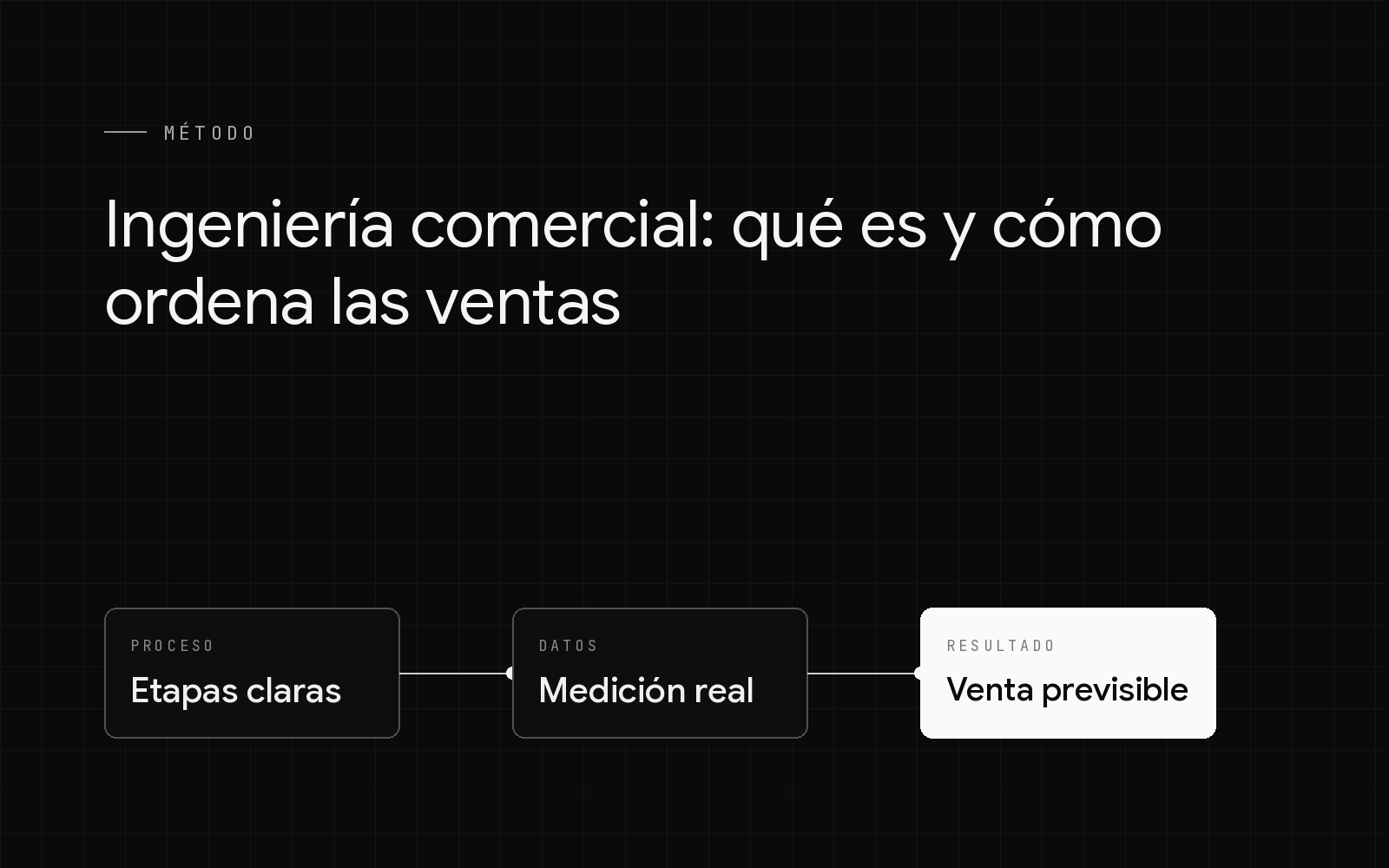
What is commercial engineering? It is the discipline of designing how a company sells as a system: it defines the sales process, supports it with tools such as a CRM and an ERP, measures it with data and automates repetitive work. The goal is predictable revenue growth that no longer depends on the talent or memory of a single person.
What is commercial engineering? A one-sentence definition
In one sentence: commercial engineering applies an engineering mindset to sales, designing the full journey from first inquiry to repeat purchase with clear rules, supporting systems and metrics that show where deals get stuck.
In several Latin American countries, Commercial Engineering is also the name of a university degree close to business administration. Inside a company, the term describes something more concrete: turning sales into a designed, measured and improvable process.
It is a cross-functional view. It touches marketing, sales, customer service, order fulfillment and billing, because a deal can be lost to an unanswered message just as easily as to a slow quote or a late invoice.
Why commercial engineering matters now
Buying habits have changed faster than many companies' selling habits. A Gartner survey published in March 2026 of 646 B2B buyers found that 67% prefer a rep-free buying experience and 45% used AI during a recent purchase.
That does not remove the sales team; it changes its role. A Gartner release from May 2026 reports that 69% of B2B buyers prefer to validate AI-generated insights with a sales rep, and that buyers used an average of seven information sources in a recent purchase.
For a growing LATAM business, the takeaway is simple: customers research on their own, across channels, and show up already informed. Winning that deal requires available information, fast responses and a team that joins the conversation with context. All of that can be designed.
The building blocks of a commercial system
When the Verzeen team reviews a company's commercial area, it organizes it in five layers, each built on the previous one:
| Layer | Question it answers | Example |
|---|---|---|
| Process | What happens, in what order, and who owns it? | Funnel stages and exit criteria for each. |
| Channels | Where do customers arrive and buy? | Online store, WhatsApp, sales reps, distributors. |
| Systems | Where is each interaction recorded? | CRM for opportunities, ERP for stock and billing. |
| Data | How do we know it works? | Stage conversion, response time, average order value. |
| Automation and AI | Which repetitive tasks can the system handle? | Quote follow-ups, first responses, alerts. |
Order matters. Automating an undefined process only speeds up the mess. To choose what to measure, see our guide to sales KPIs for small businesses.
Signs your company needs commercial engineering
- Sales depend on one person. When the owner or a key rep is away, revenue drops.
- Nobody knows how many inquiries are lost. They arrive through WhatsApp, email, social and phone with no single record.
- Quotes go unanswered. They are sent and nobody follows up.
- Each area keeps its own spreadsheet. Sales, stock and collections never match.
- Tools go unused. A CRM or dashboard was purchased, but the team went back to spreadsheets.
If two or more sound familiar, the issue is rarely effort. It is design: the commercial system grew organically and now holds the business back.
How commercial engineering is applied, step by step
- Diagnosis. Map how the company really sells today: channels, timing, tools and where opportunities leak.
- Measurement. Define a few indicators and start tracking them to set a baseline.
- Organized information. Unify customers, products and opportunities in connected systems, typically a CRM linked to the ERP.
- Automation. With a clear process and reliable data, automate repetitive tasks and add AI where it brings speed or judgment.
- Continuous improvement. Review the indicators with the team, adjust and repeat.
The focus stays on the commercial result rather than on the tool. You can see this approach in practice in our projects.
Commercial engineering and artificial intelligence
AI has expanded what can be automated in sales: classifying inquiries, drafting first replies, summarizing conversations, prioritizing opportunities or spotting customers who stopped buying. Its value depends on the system it runs on.
A WhatsApp assistant needs current prices, stock and policies; a tool that suggests who to call needs reliable sales history. In an AI-first approach, AI is part of the design from day one. Read more on AI automation for SME processes and on choosing a CRM for a small business.
Frequently asked questions
What does a commercial engineer do?
In countries such as Chile, the title refers to a university degree close to business administration and economics. Inside a company, the role designs and improves the sales system: it defines the process, selects and connects tools, sets indicators and coordinates marketing, sales and administration so growth becomes measurable.
How is commercial engineering different from sales management?
Sales management leads the team toward targets: assigning accounts, coaching reps and tracking progress. Commercial engineering designs the system the team works on: process, channels, tools, data and automation. Good commercial engineering makes sales management simpler and more objective.
Is commercial engineering the same as RevOps?
They share the idea of aligning marketing, sales and customer service around one process and one dataset. RevOps is the term mostly used in software companies. Commercial engineering applies that approach to businesses in any industry, including physical channels, distributors, e-commerce and ERP integration.
At Verzeen we work as part of your team to design and run your commercial system: we diagnose how you sell today, organize information in your CRM and ERP, measure what matters and use AI to automate what your team should not do by hand. If you want to know where to start, let's talk.