
Sales KPIs for small businesses: the metrics that actually move the needle
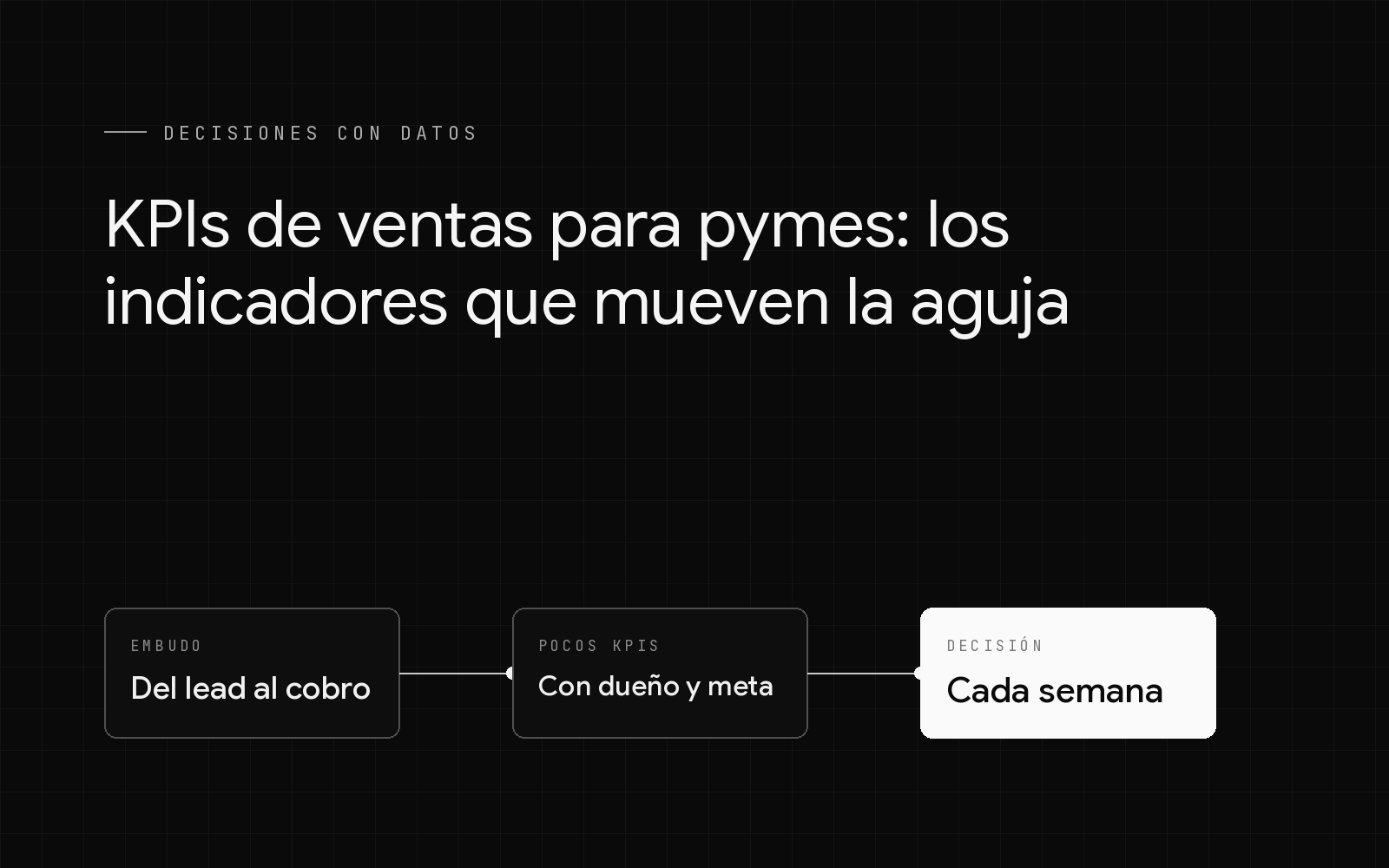
The sales KPIs for small business teams that matter are few: the ones that show how many opportunities come in, how many convert, how much each sale is worth and how long it takes to close. Ten metrics tied to real decisions beat a fifty-number dashboard nobody reads. This article organizes sales KPIs by funnel stage, with the formula and the decision each one supports.
What a sales KPI is (and what it is not)
A sales KPI is a metric that tracks progress toward a commercial goal and triggers an action when it drifts. The second half of that definition is usually missing: if a number never changes a decision, it is a reporting metric, not a KPI.
Monthly revenue is an outcome. It arrives late and does not explain why it moved. Useful KPIs look at causes: how many inquiries came in, what share moved forward and where the process broke. With those pieces, the team can correct course mid-month instead of finding out at month end.
- Outcome metrics: closed sales, revenue, margin. They show where you are.
- Process metrics: new opportunities, stage conversion, response time. They show where you are heading.
Sales KPIs by funnel stage
Organizing KPIs by stage prevents over-measuring and shows where the bottleneck is. This is the baseline our team uses when structuring the sales function of a growing LATAM company:
| Stage | KPI | How to calculate it | Decision it supports |
|---|---|---|---|
| Generation | New opportunities | Qualified inquiries per week, by channel | Where to invest in acquisition |
| Response | First response time | Hours between inquiry and first contact | Staffing, automated replies |
| Conversion | Win rate | Won deals ÷ closed deals (won + lost) | Training, proposal, pricing |
| Value | Average order value | Revenue ÷ number of sales | Bundles, cross-selling, minimums |
| Speed | Sales cycle | Average days from opportunity to close | Follow-up, commercial terms |
| Retention | Repeat purchase rate | Returning customers ÷ prior-period customers | After-sales, loyalty programs |
Six metrics are enough for most small businesses to understand what is happening. If you sell through several channels, track each KPI per channel: the overall average often hides the channel that is losing money.
How to choose sales KPIs for small business teams
A B2B distributor with a few large accounts lives on sales cycle and repeat purchases; a B2C online store lives on conversion and order value. To choose, follow this order:
- Write the year's sales goal in one sentence, with a number and a deadline.
- Break it into your business formula: opportunities × win rate × average order value × purchase frequency.
- Find the weakest variable. That is your first KPI, with a weekly target.
- Assign an owner to each KPI who reviews it and proposes action when it drifts.
- Define the data source before the dashboard.
Where the data comes from
A KPI is only as good as the data behind it. In most companies we assess, the issue is not a lack of metrics: opportunities are scattered across WhatsApp, email and each rep's memory.
The logical order is a CRM that records every opportunity with its stage, channel and outcome; then the ERP or invoicing system for order value and repeat purchases; and only then a dashboard that combines both. Tools like Odoo already calculate the ratio of won to lost opportunities in their pipeline analysis, as long as the team marks each deal as won or lost. If you are choosing where to centralize that data, see our guide to CRM for small businesses.
Common mistakes when measuring sales
- Tracking only revenue. It is the last link and arrives too late to correct.
- Too many numbers. More than eight to ten KPIs for a small sales team is usually noise.
- KPIs without targets. Use your own history as the first benchmark.
- Averages that hide differences. A stable average can mask one channel growing and another falling.
- Data entered at month end. Then KPIs measure the team's memory, not sales.
Many of these mistakes share one symptom: a dashboard built once and never opened again. We cover it in the dashboard nobody uses.
A weekly routine that keeps KPIs in use
KPIs produce results when they are part of a fixed team conversation. A thirty-minute weekly meeting is enough if it always follows the same structure:
- What changed: the six KPIs against last week and against target.
- Why: each owner explains their deviation with data.
- What we do: one concrete action per deviation, with an owner and a date.
- What we automate: recurring tasks, such as follow-up reminders or alerts for unanswered quotes, move into an automated workflow.
Measure first, organize information next, automate last. One well-chosen KPI reviewed every week moves the needle more than any new tool.
Frequently asked questions
What are the most important sales KPIs?
For a small business, the most useful are new opportunities by channel, first response time, win rate, average order value, sales cycle length and repeat purchase rate. Together they cover the whole funnel, from first inquiry to returning customer, and each one connects to a concrete decision for the sales team.
How many KPIs should a small business track?
Five to ten for the sales function is usually enough. More metrics do not add control; they scatter attention and get the dashboard abandoned. Start with the KPI for the weakest funnel stage, with a weekly target and an owner, and add metrics as the team builds them into its routine.
How do you calculate sales win rate?
Divide the number of won opportunities by the total number of closed opportunities in the period, meaning won plus lost, and multiply by one hundred. For the figure to be reliable, every opportunity must be recorded in the CRM with its final outcome, including deals that are lost or stop responding.
What is the difference between a metric and a KPI?
A metric is any measurable data point, such as website visits or messages received. A KPI is a metric chosen because it is tied to a business goal, has a target and triggers an action when it drifts. Every KPI is a metric, but very few metrics deserve to be KPIs.
At Verzeen we work as part of your team to define the sales KPIs that matter, organize the data behind them and build dashboards your team uses every week. If you want to know which metrics to look at first, let's talk.