
Automate WhatsApp Business with AI: what works and what doesn't
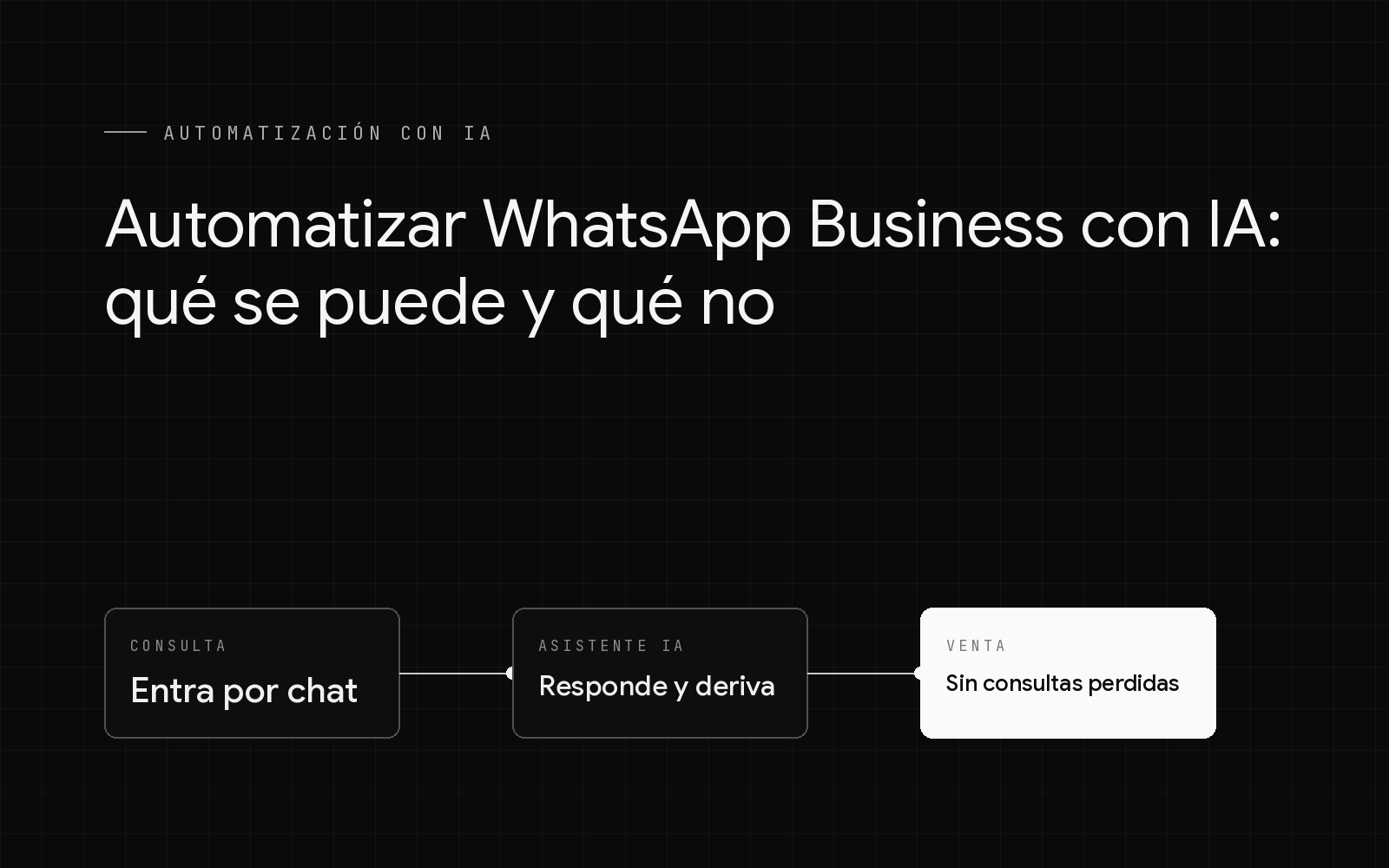
You can automate WhatsApp Business with AI to answer common questions, qualify leads, collect order details and route each conversation to the right person. What you should not automate are negotiations, sensitive complaints and any answer that depends on information the AI does not have. The gap between a helpful assistant and one that drives customers away lies in the flow design, not the tool.
What it means to automate WhatsApp Business with AI
In one sentence: automating WhatsApp Business with AI means connecting your company number to an assistant that understands what customers write, answers with your business information and hands over to the team whatever needs human judgment.
That is a step beyond classic auto-replies. A greeting or away message always says the same thing; an assistant built on a language model interprets the question, checks your catalog, prices or knowledge base and writes an answer for that specific case.
For a LATAM SME selling through WhatsApp, the value sits in two places: replying within minutes at any hour, and recording every conversation as commercial data instead of leaving it on one person's phone.
WhatsApp Business app or API: two different paths
The first decision is technical, but it has commercial consequences:
| WhatsApp Business app | WhatsApp Business Platform (API) | |
|---|---|---|
| Best for | Small teams, few devices | Teams that split conversations across several people |
| Automation | Greeting, away messages, quick replies | AI assistants, flows, CRM and ERP integration |
| Meta fees | No per-message fee | Per-message fee by category and country |
| Data | Stays on the phones | Recorded in your systems |
Real AI automation requires the API, usually through a provider that connects it to your CRM and to platforms such as n8n or Make. Unofficial tools that "automate" the app from a computer are a risk: they rely on usage WhatsApp does not authorize, and the number can be banned.
What you can automate with AI on WhatsApp
- FAQs: opening hours, payment methods, delivery times, shipping areas, return policies.
- Lead qualification: asking what the customer needs, when, how much and from where before handing over to sales.
- Catalog and stock: confirming availability and price by querying your system, not an outdated list.
- Orders and appointments: capturing complete details so the team only confirms.
- Follow-up: order status updates, appointment reminders and follow-up on quotes.
- Smart routing: sending each conversation to the right salesperson or area, with a summary of what was discussed.
An assistant answers well when it has good information behind it. That is why an organized knowledge base is often the first step, before the chatbot.
What not to automate (and what Meta does not allow)
- Price and terms negotiations in large or B2B deals.
- Complaints from upset customers, where empathy matters more than speed.
- Answers that commit the company: special deadlines, exceptions, custom quotes.
- Sensitive topics, such as health data or customer financial information.
Meta sets its own limits too. Since January 15, 2026, the WhatsApp Business API terms bar AI providers from offering general-purpose assistants when AI is the primary service, as TechCrunch reported. Businesses can still use AI to serve their own customers: an assistant that answers about your products, orders and services is allowed.
How much it costs to automate WhatsApp Business
Cost has three parts: Meta's per-message fees, the platform provider's fee and the work of designing and integrating the flow. According to Meta's official pricing documentation:
- Since July 2025, Meta charges per delivered message, with rates by category (marketing, utility, authentication, service) and recipient country.
- The customer service window lasts 24 hours from the customer's last message. Outside it, only approved templates can be sent.
- Each number gets 1,000 free service messages per month; since October 1, 2026, messages beyond that tier are charged.
For an SME, the number that matters is not cost per message but cost per inquiry handled, compared with the sales lost today to slow replies.
Design the flow before choosing the tool
- Diagnosis: read a real sample of conversations and classify what customers ask and where chats stall.
- Measurement: first response time, unanswered inquiries and close rate per salesperson.
- Organized information: catalog, prices, policies and standard answers in one place, connected to your CRM.
- Automation: only then, the AI assistant, with clear rules for when to hand over to a person.
A good sign the flow works: the team gets fewer messages, but better qualified and with context. To dig into where chat-based sales get stuck, read WhatsApp friction in ecommerce, and for the bigger picture, AI automation for SMEs.
Frequently asked questions
Can I add an AI chatbot to WhatsApp Business?
Yes, through the WhatsApp Business Platform API, usually via an authorized provider that connects your number to a language model and your systems. The free app only offers greeting, away messages and quick replies. Since 2026, Meta allows businesses to use AI to serve their customers, but not general-purpose assistants.
How much does the WhatsApp Business API cost?
Meta charges per delivered message, with rates by message category and recipient country. Each number gets 1,000 free service messages per month, and since October 2026 messages above that are charged. Add the platform provider's fee and the integration work.
Will AI replace my sales team on WhatsApp?
That is not the goal. AI handles repetitive tasks: FAQs, data capture and lead qualification. The team keeps conversations that need judgment, such as negotiating, resolving complaints or building proposals. The aim is for each salesperson to receive better-qualified inquiries with context.
At Verzeen we work as part of your team to organize your WhatsApp channel: we diagnose real conversations, connect your number to your CRM and design AI assistants that answer well and hand over on time. If you want every inquiry answered, let's talk.