AI knowledge base: so your company's know-how doesn't depend on one person
Almost every company has someone who "knows everything". They know which customer has special terms, how a certain quote is built, where the manual for a given machine is. That person is valuable, and also a risk: when they're busy, everyone waits; when they leave, the knowledge leaves with them.
The problem isn't a lack of information
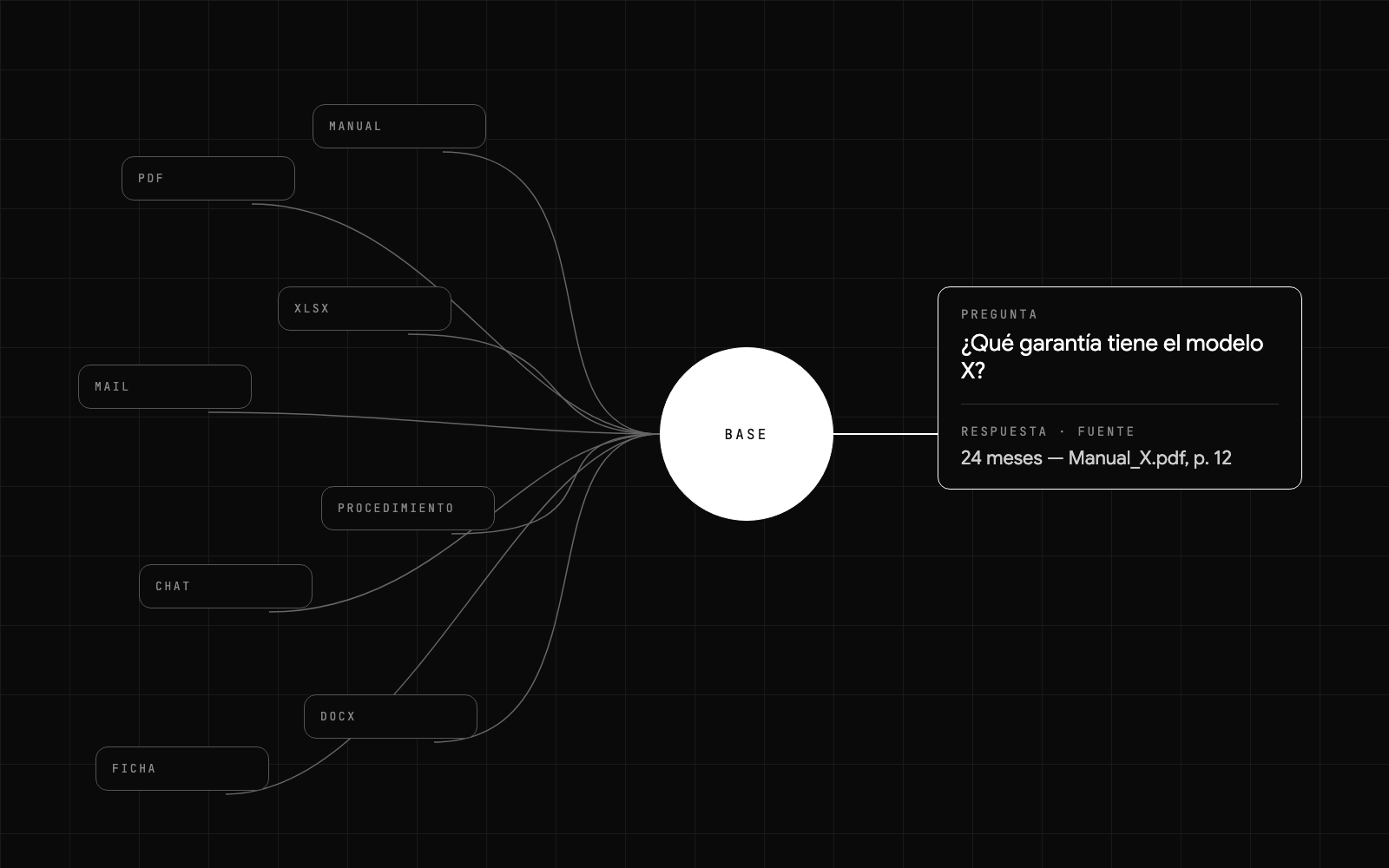
The information almost always exists. It's in manuals, procedures, emails, price lists, chats and shared folders. The problem is that it's scattered, and finding it takes longer than asking someone. So people ask, and that person ends up being the company's search engine.
What an AI knowledge base is
It's an assistant that answers questions in natural language using your company's documentation. Someone on the team asks "what's the warranty on model X?" and gets the answer, along with a reference to the document it came from.
Technically it relies on an approach called RAG (retrieval-augmented generation): for each question, the system finds the relevant passages in the company's documents and the AI model writes the answer from them. It answers based on what's documented, cites the source and, when it can't find the answer, says so.
Where it has the most impact
- Onboarding. New team members get their questions answered without waiting for someone to have time to explain.
- Sales and customer service. Consistent answers on products, prices and terms, no matter who responds.
- Operations and technical support. Procedures, manuals and spec sheets available in seconds, including from a phone.
- Quality and compliance. The current procedure, always the same, for everyone.
How it's implemented
- Map the sources. Which documents exist, where they live and which are consulted most.
- Organize and clean up. Outdated or contradictory documents are the main risk: the assistant answers with what it finds.
- Define access. Not everyone needs to see everything. Answers respect each area's permissions.
- Integrate it where the team already works. Internal chat, WhatsApp, intranet. If people have to open another tool, they won't use it.
- Measure and improve. Unanswered questions reveal which documentation is missing.
More than a search engine
A well-maintained knowledge base becomes a company asset: it documents how things are done, reduces errors and lets the business grow without every new person depending on those already there.
It's also the foundation for what comes next: AI automations that answer customer inquiries with the same information the team uses, and operations systematized end to end.
Frequently asked questions
Is it safe to load company information into an AI?
It depends on how it's implemented. A corporate knowledge base is set up with per-area access controls and on services that don't use company data to train their models.
What happens when documentation changes?
The source is updated and the assistant answers with the new version. Connected to shared folders, updates happen automatically.
What kinds of documents can be included?
PDFs, text documents, spreadsheets, internal pages and, depending on the case, historical support conversations or tickets.
At Verzeen we work as part of your team to map, implement and support every stage. If you want to know where to start, let's talk.