
ERP for SMEs: 7 signs your company already needs one
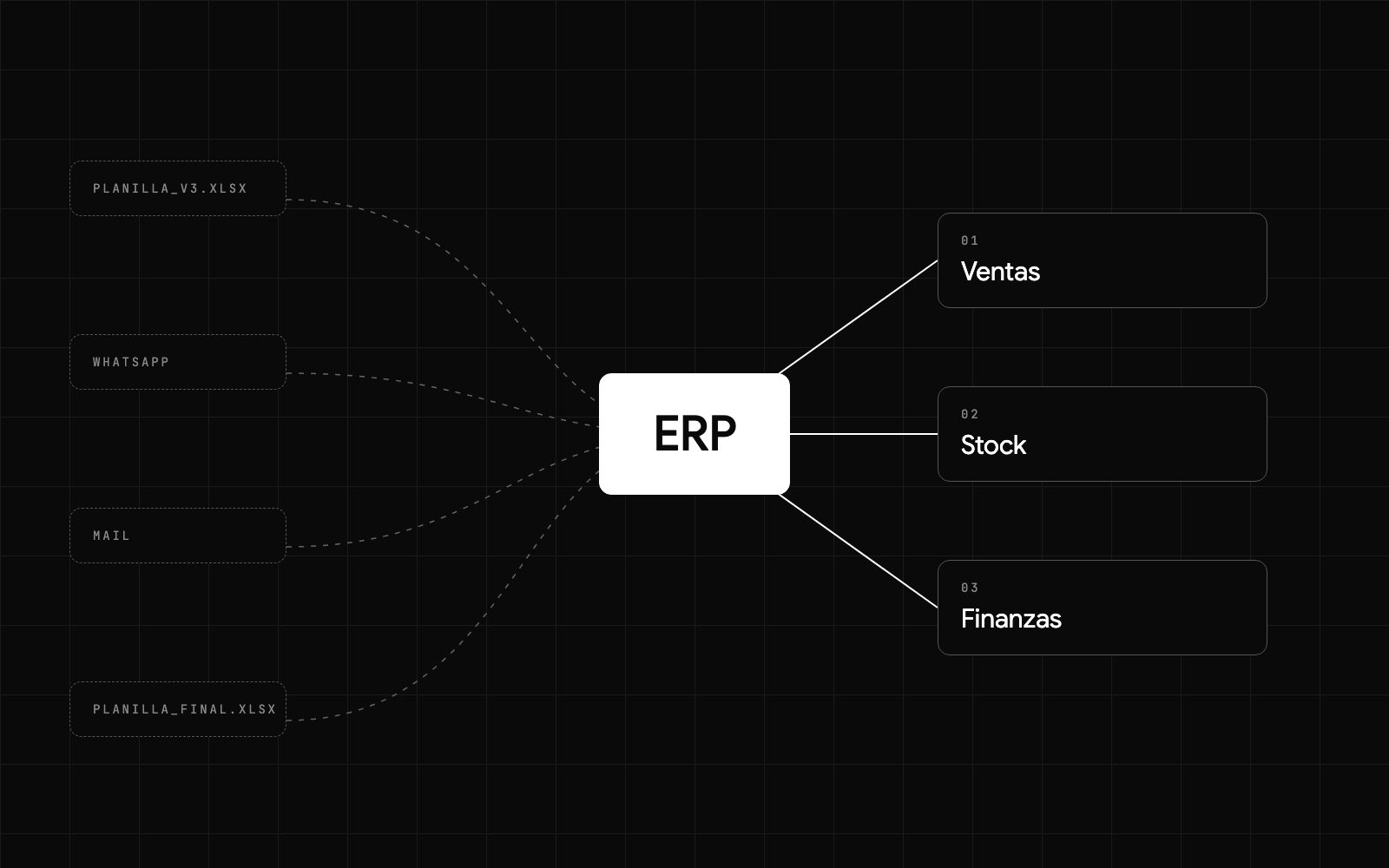
No company decides to implement an ERP on a random Tuesday. The decision comes after months of symptoms: spreadsheets that don't match, orders lost between WhatsApp and email, month-end closes that take a week. The problem is that those symptoms become normal, and what's normal stops being visible.
What an ERP is (and what changes day to day)
An ERP (Enterprise Resource Planning) system brings together in a single database the areas that today probably run separately: sales, purchasing, inventory, invoicing, finance and, often, customer relationships (CRM). What matters isn't the software itself but that the whole team works on the same data: when a sale is entered, stock is deducted, the invoice is issued and the customer account is updated, without anyone retyping it.
It isn't a project reserved for large companies either. Platforms like Odoo let you start with the modules that hurt the most and add the rest as the business grows.
7 signs your business needs an ERP
- There's more than one version of the truth. Sales has one number, accounting another, and the meeting is spent arguing over which spreadsheet is right.
- Nobody knows actual stock without counting it. You sell what you don't have or buy what you already have too much of.
- Month-end close takes days. Reconciling, consolidating and fixing by hand eats the time that should go to analysis.
- Some processes depend on a single person. If the person who invoices goes on vacation, invoicing stops.
- Orders arrive through five different channels —online store, WhatsApp, email, sales reps, phone— and get consolidated by copy and paste.
- You want to use AI or dashboards, but your data isn't organized. Without an integrated base, any AI initiative stays stuck in pilot mode. We cover this in why AI in LATAM fails without an ERP.
- Growing means hiring more people to enter data. If every new sale adds proportional admin work, the model doesn't scale.
If three or more sound familiar, the cost of not having an integrated system probably already exceeds the cost of implementing one.
How to implement an ERP without stopping operations
The most common fear is that the ERP will paralyze the company for months. That happens when everything is migrated at once. A phased approach avoids it:
- Map before configuring. Understand how each process works today, where data is entered and who uses it. The system adapts to the business, not the other way around.
- Start with the module that hurts the most. Usually sales and inventory, or invoicing. A focused first phase shows results in weeks.
- Migrate clean data. Customers, products and balances are cleaned up before import. Loading the mess into a new system only makes it faster.
- Integrate existing channels. Online store, payment methods and e-invoicing connected to the ERP, so each piece of data is entered once.
- Train with real cases. The team learns with its own orders and customers, not a generic manual.
What changes afterwards
With operations systematized, the questions change. It's no longer "how much did we sell?", because it's on screen. It's "which product should we push?", "which customer is buying less?", "which process can we automate?".
That's the starting point for everything else: dashboards that are actually used to decide and AI automations running on reliable information.
Frequently asked questions
How long does it take to implement an ERP in an SME?
It depends on scope, but a first phase focused on sales, inventory and invoicing is usually up and running in weeks, not months. The remaining modules are added in stages.
Does Odoo work for companies in Argentina?
Yes. Odoo has an Argentine localization covering the local chart of accounts, taxes and ARCA (formerly AFIP) electronic invoicing.
Can the online store be connected to the ERP?
Yes. The most widely used e-commerce platforms, such as WooCommerce, Tiendanube or Shopify, can be integrated to sync orders, stock and prices.
At Verzeen we work as part of your team to map, implement and support every stage. If you want to know where to start, let's talk.