
AI in customer service: reply in minutes without losing quality
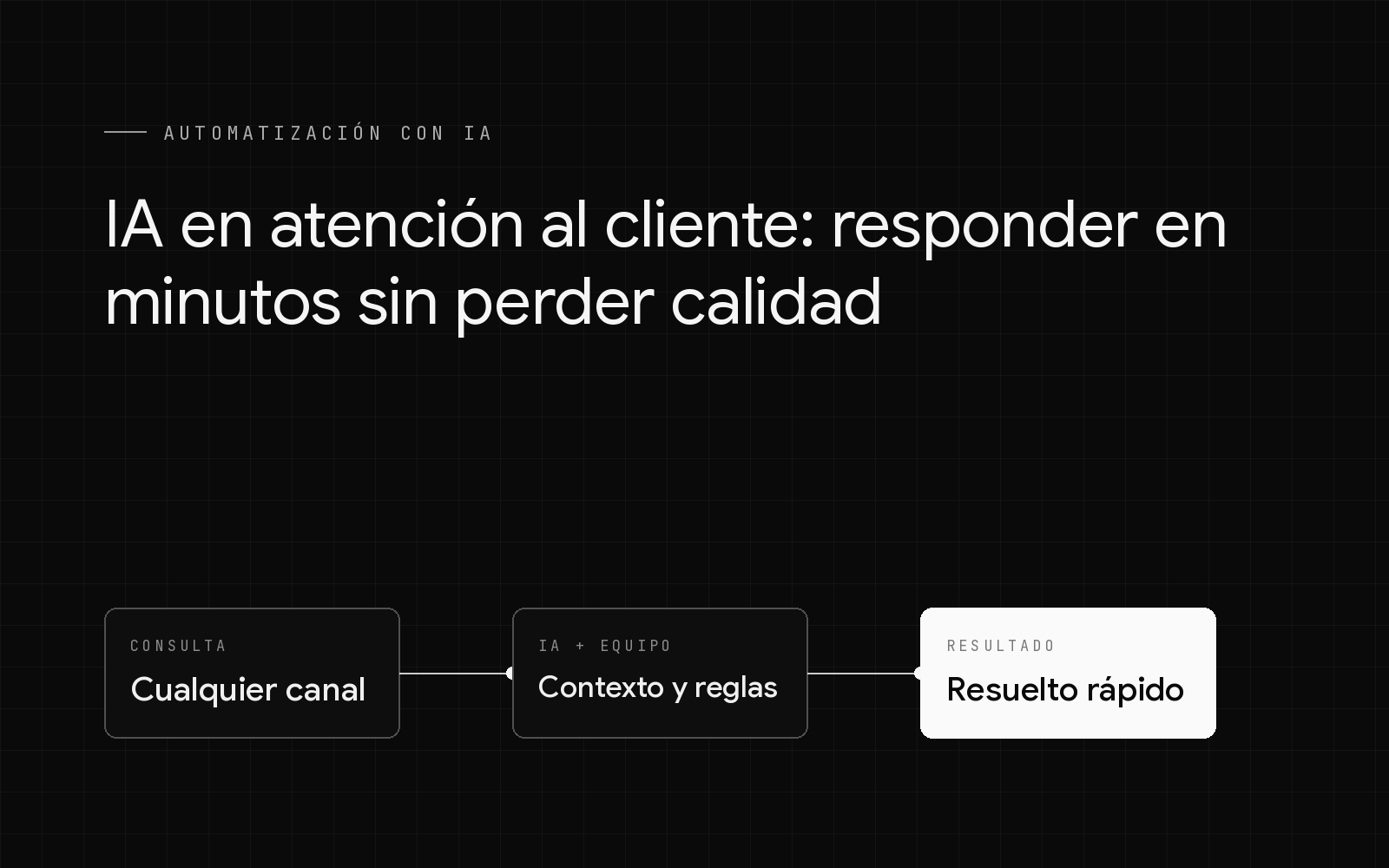
AI in customer service pays off when it answers repetitive questions instantly, organizes the rest with full context and hands off to a person whatever needs judgment. Designed well, it cuts response times from hours to minutes and frees your team for the cases that decide a sale or keep a customer.
What AI in customer service is and what it solves
AI in customer service is a system that understands requests in natural language, answers with the company's own information and decides when a case should go to a person. It runs on the channels a business already uses: WhatsApp, email, the online store chat or social media.
Unlike a menu bot, it does not force customers to pick options. It reads the question, searches an organized knowledge base, checks ERP or CRM data such as order status or account balance, and replies in the same thread.
For an SME selling across several channels in LATAM, the most visible result is speed: a question sent at 11 p.m. gets answered at 11 p.m., and the team starts the day with cases already sorted.
Why response speed matters more every year
Customer expectations keep rising. Zendesk's CX Trends 2026 report, based on more than 11,000 respondents in 22 countries, found that 87% of consumers have higher response expectations than the year before and 80% want whoever serves them to have instant access to their history.
In Latin America, Apex America data reported by Revista Mercado shows that 88% of customers demand an immediate answer, 63% are frustrated by long waits and 54% dislike repeating their personal details.
For an SME, this means revenue: a price inquiry left waiting all afternoon often ends with a competitor.
What to automate and what to leave to your team
Sort requests by frequency and risk. Frequent, low-risk questions are automated first; anything involving a commercial decision or an upset customer stays with the team.
| Request type | Who answers | Example |
|---|---|---|
| General information | AI | Hours, payment methods, shipping areas |
| Order or account status | AI connected to systems | Where is my order, when is my invoice due |
| Product questions | AI with knowledge base | Sizes, compatibility, stock |
| Quotes and discounts | AI prepares, team decides | Volume quote for a wholesale client |
| Complaints and returns | Team, with AI summary | Damaged product, late delivery |
Many businesses start with WhatsApp, where most of the volume is; see how to automate WhatsApp Business with AI.
How to keep quality high: context, rules and handoff
- An organized knowledge base. AI answers with what the company has documented: policies, current prices, FAQs, product sheets. Start with an AI knowledge base.
- Explicit rules. For example: it quotes list prices but does not offer discounts; it reports shipping status but does not promise dates the system has not confirmed.
- Handoff with context. When a case reaches a person, it arrives with a conversation summary, customer data and detected intent, so the customer never repeats anything.
The same Zendesk report found that 89% of CX leaders believe customers abandon brands that fail to resolve issues on first contact. A good handoff is what makes first-contact resolution possible even when a person steps in.
Metrics for AI in customer service
- First response time, by channel and time of day.
- Automated resolution rate: conversations closed without human help and without the customer writing back about the same issue.
- Handoff rate and reason, which shows what the knowledge base is missing.
- Satisfaction per conversation, comparing AI-resolved and team-resolved cases.
- Conversions from service: conversations that ended in an order or an accepted quote.
A weekly review of real conversations completes the picture.
Common mistakes
- Automating before organizing information. AI amplifies whatever it finds, including outdated data.
- Hiding the option to talk to a person.
- Not connecting AI to your systems. Without ERP or CRM access, answers stay generic.
- Measuring only hours saved. The value also lies in sales not lost to delays.
- Launching everything at once. Start with one channel and a small set of questions, then expand.
When service involves several steps, such as checking stock, generating a quote and logging it in the CRM, the design moves closer to AI agents for business.
Frequently asked questions
Will AI replace the customer service team?
In an SME, AI takes over repetitive questions and the work of sorting and summarizing, while the team focuses on complaints, negotiations and key accounts. The usual result is that the same people handle more volume with better quality.
Which channels can AI handle?
The most common are WhatsApp, the online store chat, email and Instagram and Facebook messages. Ideally they all share the same knowledge base and customer history, so answers stay consistent.
How do I stop AI from giving wrong answers?
Limit its sources to official company information, define clear rules about what it can promise and set up a handoff to a person when it cannot find a reliable answer. Review a sample of conversations every week and update the knowledge base.
Where should I start?
With the channel that receives the most requests and the five to ten questions asked most often. Build a first version, measure response time, resolution and satisfaction for a few weeks, and expand from there.
At Verzeen we work as part of your team to design AI-powered customer service end to end: we organize the knowledge base, connect channels to your ERP and CRM, define handoff rules and measure results, as we have done in our projects. If you want to reply in minutes without losing quality, let's talk.