
AI agents for business: what they are and where they already deliver results
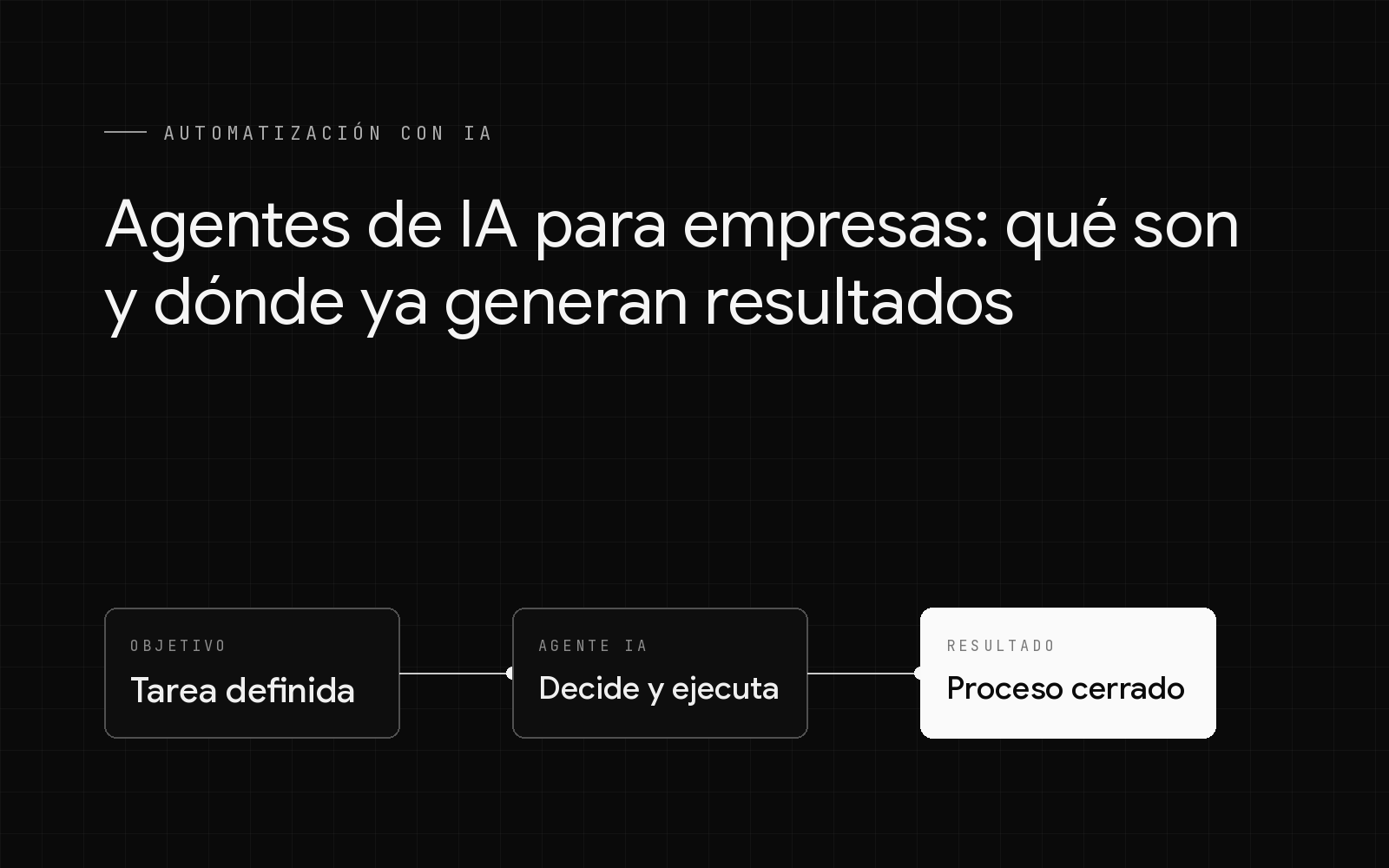
AI agents for business are systems that take a goal, decide the steps to reach it and carry them out using the company's own tools: the CRM, the ERP, email or WhatsApp. They perform best in repetitive processes with clear rules and organized data, such as qualifying leads, following up on quotes or preparing reports. Where information is scattered, the first step is to organize it.
What an AI agent is and how it differs from a chatbot
In one sentence: an AI agent is software that, given a goal, reasons about what to do, uses tools to do it and checks the result, with little human input at each step.
| What it does | Example | |
|---|---|---|
| Rule-based automation | Runs the same sequence whenever a trigger fires. | When a form is submitted, create a contact in the CRM. |
| Chatbot or assistant | Answers questions with business information. | Replying with opening hours, prices or order status. |
| AI agent | Chooses the steps, queries systems, acts and escalates when needed. | Reading an inquiry, finding the customer in the CRM, building a quote with ERP prices and scheduling the follow-up. |
An agent combines three parts: a language model that interprets and decides, connections to company systems to read and write data, and rules that define what it can do alone and what must go through a person.
Where AI agents for business already deliver results
McKinsey's The state of AI in 2026 shows uneven adoption: 40% of large organizations are scaling agents in at least one function, compared with 22% of smaller ones. Agents are scaled most often in IT, knowledge management and software engineering; in consumer goods and retail, in marketing and sales.
In the commercial operation of a LATAM SME, the use cases that work are concrete:
- Lead qualification. The agent reads every message from the website, email or WhatsApp, logs it in the CRM and ranks the ones most likely to close.
- Quote follow-up. It spots unanswered quotes and drafts a reminder with the context of the conversation for the sales team.
- Weekly reporting. It combines sales, collections and inventory and summarizes what changed.
- Internal answers. It answers questions about prices, policies or procedures using the company knowledge base.
- Data entry. It reads purchase orders or invoices and loads them into the ERP for review.
Why many agent projects never reach production
Gartner predicts that over 40% of agentic AI projects will be canceled by the end of 2027, citing rising costs, unclear business value or inadequate risk controls. In SMEs the causes are familiar: scattered data, undefined processes, vague goals and too much autonomy too early. An agent decides with whatever information it finds, so if customers live in three spreadsheets, its decisions will reflect that.
How to implement AI agents in five steps
- Diagnosis. Map the real process: who does it, with which data, how long it takes and where money or time is lost.
- Measurement. Define the metric the agent must move and record its current value.
- Organized information. Move the data the agent needs into a reliable system, usually the CRM or ERP.
- Supervised agent. Start with the agent proposing and a person approving.
- Gradual autonomy. Once results are consistent, expand what the agent handles alone and keep human review on sensitive decisions.
Automation platforms such as n8n or Make connect the language model with the systems the company already uses. We cover this in more detail in our article on AI automation for SMEs.
What to keep in human hands
A well-designed agent knows when to escalate. Price negotiations, sensitive complaints, commercial exceptions and decisions affecting key accounts should go through someone on the team. The agent handles the repetitive work and prepares the complex cases; people decide. For messaging channels, see our guide to automating WhatsApp Business with AI.
Is your company ready for an agent?
Three questions guide the decision. Is there a process repeated many times a week with similar steps? Does the data it needs live in a system rather than in someone's memory? Can you measure today what that process costs or how many sales are lost in it? Three yeses mean a focused agent can be running within weeks. Any no means the path starts with organizing information, which pays off on its own.
Frequently asked questions
What is an AI agent in a business?
It is software built on a language model that takes a goal, decides the steps to reach it and carries them out by connecting to business systems such as the CRM, ERP or email. Unlike a chatbot, which answers questions, an agent acts: it records data, prepares documents, schedules tasks and hands over to a person when needed.
What is the difference between an AI agent and automation?
Classic automation always follows the same sequence when a trigger fires. An AI agent interprets each case and chooses what to do, so it handles tasks with variations, like inquiries written in different ways. In practice they work together: automation moves data between systems and the agent adds judgment where it is needed.
Can a small business use AI agents?
Yes, as long as it starts with a focused process, organized data and a clear metric. Lead qualification, quote follow-up and weekly reports are good first cases. Success depends more on data quality and process definition than on company size.
Will AI agents replace the sales team?
They change how the team spends its time. The agent takes over data entry, reminders and inquiry sorting, and prepares opportunities. Negotiations, sensitive complaints and key commercial decisions stay with people, who reach those conversations with more context.
At Verzeen we work as part of your team to design AI agents on top of measured processes and organized data: we diagnose where time or sales are lost, systematize the information and launch supervised agents until results are consistent. If you want to know which process to tackle first, let's talk.