
The AI Blind Spot in SMEs: The Sales Process
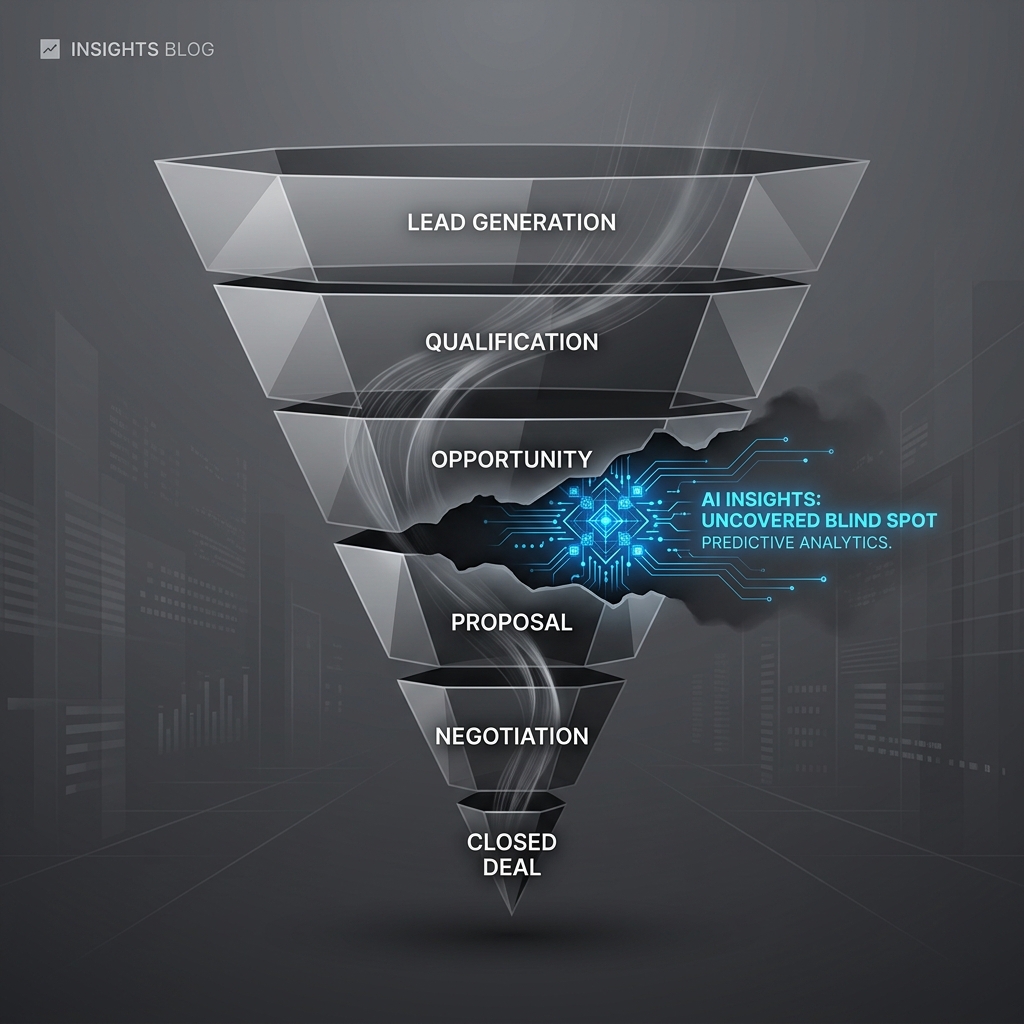
The adoption of AI in Argentine SMEs advanced faster than many anticipated. But when you look closely at where it is being applied, a dark area appears that is hard to ignore: the sales process.
Marketing and customer service currently concentrate the majority of implementations. Chatbots that answer queries, content generation, campaign segmentation: all of this is already part of the day-to-day of many companies. The pipeline, on the other hand, continues to function almost exactly as it did ten years ago.
Where the funnel breaks
Lead follow-up depends on the discipline of each salesperson. The prioritization of opportunities is intuitive: the one who insists the most is attended to first, not the one with the highest probability of closing. And deviations in the funnel —a stage that stalls, a segment that stops converting— are detected weeks late, when the quarter is already compromised.
It's not an operational detail. It's the bottleneck that defines how much a company can grow without adding headcount. As long as the pipeline depends on people's memory, every new salesperson is a new system that needs to be trained from scratch, and every salesperson who leaves takes their method with them.
The invisible cost
The question worth asking is not whether it is convenient to use AI in sales. It is how much it is costing every month not to use it yet.
That cost almost never appears in a report, because it's not seen as an expense: it's seen as opportunities that went cold, quotes that no one followed up on, customers who bought elsewhere because you answered three days late. Added up over a year, it is usually greater than that of any tool that could have been implemented.
What a systematic pipeline looks like
An orderly sales process does not depend on remembering. Every lead enters a CRM with clear rules for assignment and follow-up. Prioritization is based on data —origin, behavior, stage— and not on the intuition of the moment. Deviations are seen on a dashboard, the day they occur, not at the end-of-the-month meeting.
AI doesn't replace the salesperson. It takes the mechanical part off their shoulders —logging, reminding, status updating— so they can dedicate their time to what a machine doesn't do: converse and close.
Where to start
The most common mistake is starting by buying the tool. The correct order is reversed: first understand how the funnel works today, where it loses, and which part of the process should be systematized first. Only then does it make sense to decide what to automate and with what.
In your company, is the pipeline already systematic, or does it still depend on the memory of each salesperson?